
AI Cooling Technologies for Modern Data Centers
The growth of computing workloads, increased server equipment density, and the widespread adoption of high-performance systems, including AI servers, have made cooling one of the key factors for stable data center operations. Traditional approaches based on fixed control scenarios and static configurations are increasingly proving insufficient under dynamically changing workloads.
Modern data centers consume a significant portion of their energy specifically for cooling systems. Any deviations in temperature regimes directly affect equipment reliability, service life, and overall infrastructure energy efficiency. Under these conditions, there is a growing need for more flexible and adaptive approaches to managing climate and thermal flows.
AI cooling technologies represent an evolution of traditional cooling systems through the use of machine learning algorithms and real-time analytics. These solutions not only maintain predefined parameters but also predict workload changes, optimize the operation of engineering systems, and reduce energy consumption without compromising stability.
The role of cooling in modern data center architecture
Cooling is one of the core engineering subsystems of a data center and directly impacts the reliability, energy efficiency, and scalability of IT infrastructure. As computing workloads grow, requirements for cooling systems become increasingly stringent and complex.
Increasing server equipment density
Modern servers and compute nodes have high thermal density. The use of powerful CPUs, GPUs, and accelerators leads to a significant increase in heat output per unit area. Under such conditions, standard air cooling schemes without intelligent control lose efficiency and require constant reconfiguration.
Energy consumption and efficiency metrics
Cooling systems account for a substantial share of a data center’s total energy consumption. Inefficient climate control results in excessive energy use and deterioration of energy efficiency metrics, including PUE. Cooling optimization becomes one of the most effective ways to reduce operational costs.
Impact of overheating on infrastructure reliability
Even short-term temperature threshold exceedances increase the risk of equipment failures and reduce hardware lifespan. Overheating can also cause performance degradation and service instability. Therefore, cooling systems must not only maintain target parameters but also rapidly adapt to changes in workload.
What are AI-based cooling technologies
AI-based cooling technologies are an approach to managing data center cooling systems based on the use of machine learning algorithms, large-scale data analytics, and automated decision-making. These solutions make it possible to move from static control scenarios to dynamic, real-time optimization.
Basic operating principle
At the core of AI cooling is continuous data collection from temperature, humidity, power consumption, and equipment load sensors. This data is analyzed by machine learning algorithms that identify patterns and relationships between workloads, thermal flows, and the operation of engineering systems. Based on this analysis, the system generates optimal control actions.
Data sources and inputs
For AI-based cooling to function correctly, data is collected from multiple sources, including server equipment, cooling systems, power supply infrastructure, and monitoring platforms. The higher the quality and completeness of the data, the more accurately algorithms can predict changes and make decisions.
Differences from traditional control systems
Traditional cooling control systems operate based on predefined rules and threshold values. AI-based solutions, by contrast, adapt to changing conditions, take historical data into account, and are capable of predicting future states. This enables reduced energy consumption and improved stability without manual intervention.
Main types of AI cooling solutions
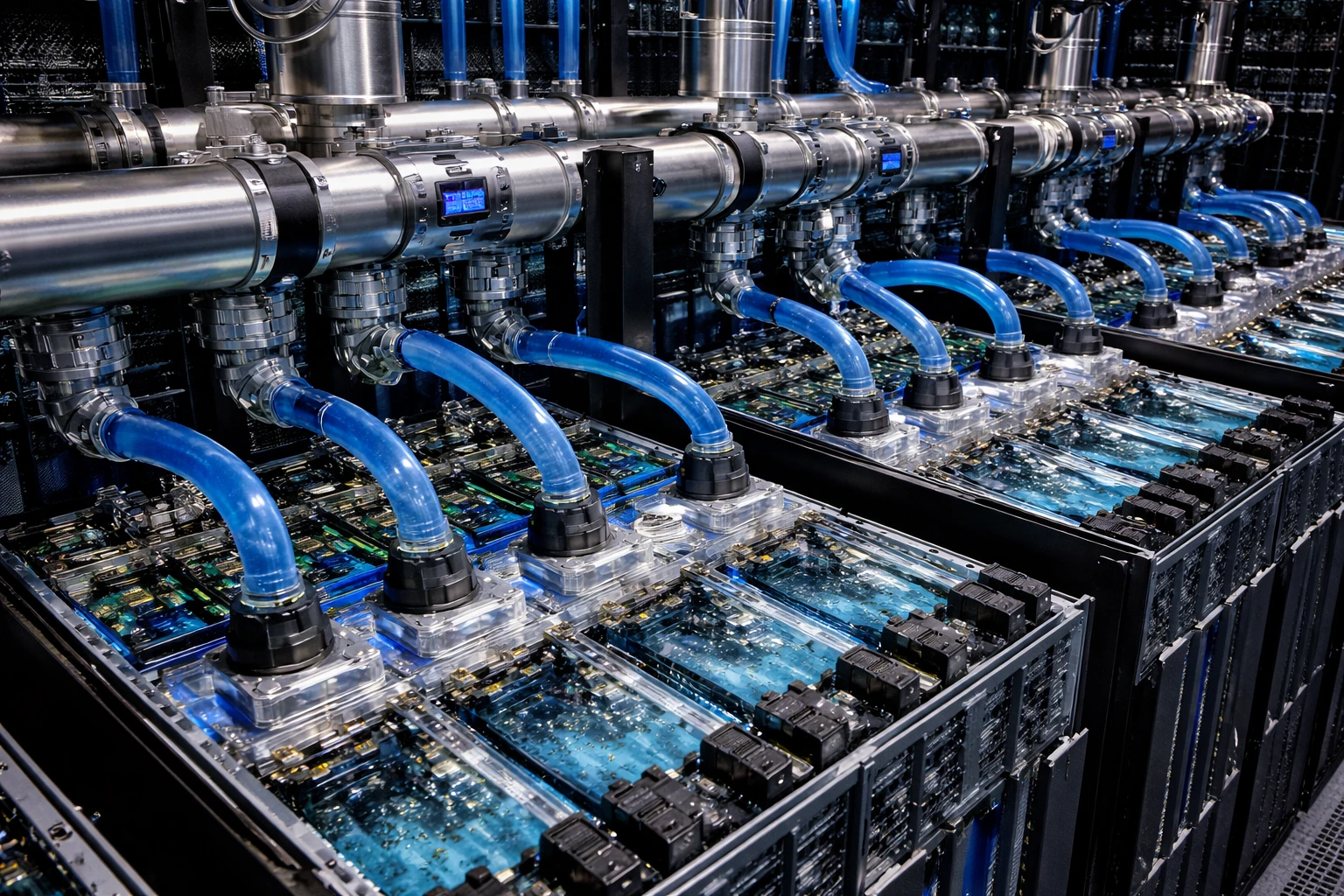
AI cooling technologies can be applied across different cooling architectures and at various levels of data center management. Depending on the engineering systems in use and optimization objectives, several main types of solutions can be distinguished.
- Intelligent air cooling control. In air-based cooling systems, AI is used to dynamically manage airflow, fan speeds, and cooling unit operation. Algorithms analyze temperature distribution within data halls and adjust cooling parameters based on actual workloads, eliminating local hotspots and overcooling.
- AI optimization of liquid cooling. Liquid cooling is used in data centers with high equipment density and thermal loads. AI helps optimize coolant circulation, regulate heat exchange, and balance the system according to current conditions. This is particularly relevant for GPU clusters and high-performance computing environments.
- Predictive temperature and workload management. Predictive models forecast changes in thermal loads based on historical data and current trends. Based on these forecasts, the system prepares engineering infrastructure in advance, reducing the risk of overheating and sudden spikes in energy consumption.
How AI cooling works in a data center
AI cooling technologies are integrated into the existing engineering infrastructure of a data center and operate as an overlay on top of monitoring and control systems. Their purpose is to maintain an optimal balance between thermal stability and energy efficiency.
- Real-time data collection and analysis. The system continuously receives data from temperature, humidity, and power consumption sensors, as well as from server equipment and engineering subsystems. This data is aggregated and analyzed in real time, enabling an up-to-date view of thermal processes within the data center.
- Machine learning models and analytics. Based on the collected data, machine learning models are trained to identify patterns and relationships between workloads and heat generation. These models take into account both current parameters and historical data, allowing them to predict future changes and proactively adjust cooling system operation.
- Automated control of engineering systems. AI cooling solutions generate control commands for cooling systems, fans, pumps, and other components. Control is performed automatically, without the need for manual intervention, while adhering to predefined safety and infrastructure reliability constraints.
Practical benefits of AI cooling
The use of AI cooling technologies enables data centers to improve the efficiency of engineering systems and adapt to increasing infrastructure complexity. The practical impact is reflected across several key areas.
Reduced energy consumption
AI-based cooling management eliminates overcooling and optimizes engineering system operation based on actual workloads. This leads to lower overall energy consumption and improved data center energy efficiency metrics.
Improved cooling efficiency
Machine learning algorithms enable more precise allocation of cooling resources. The system focuses on areas with increased thermal load, preventing local hotspots and improving temperature stability.
Stability and fault tolerance
Through prediction and automated adaptation, AI cooling reduces the likelihood of overheating and emergency situations. The system can respond to workload changes faster than traditional control methods, increasing overall infrastructure reliability.
Lower operational costs
Energy optimization and automated control of engineering systems reduce operational expenses. In addition, the need for manual tuning and continuous monitoring by personnel is significantly reduced.
Limitations and implementation requirements
Despite their clear advantages, AI cooling technologies require certain conditions to operate effectively. When planning implementation, it is important to consider both technical and organizational constraints.
Infrastructure requirements
For AI-based systems to function correctly, a well-developed sensor and monitoring infrastructure is required. An insufficient number of measurement points or outdated equipment reduces analytical accuracy and cooling control efficiency.
Data quality and integration
Machine learning algorithms directly depend on the quality of input data. Incomplete, inaccurate, or inconsistent data can lead to incorrect decisions. Integration of AI cooling with existing engineering infrastructure management systems and DCIM platforms is also required.
Operational and organizational aspects
The implementation of AI cooling changes data center operational processes. Personnel must understand the logic of the system, monitor the correctness of its decisions, and establish new interaction procedures between IT and engineering teams.
Which data centers and companies benefit from AI cooling technologies
AI cooling technologies are most effective in infrastructures with high equipment density, dynamic workloads, and significant cooling-related costs. Their use is not justified in all scenarios, but in certain cases delivers a noticeable operational impact.
- Hyperscalers and large data centers. Large-scale data centers and hyperscalers operate with massive computing workloads and complex engineering systems. For such facilities, even minor improvements in cooling efficiency can result in substantial energy savings and reduced operational costs.
- Colocation data centers. Colocation data centers use AI cooling to optimize cooling under mixed workloads and varying client equipment density. Intelligent control helps maintain stable operating conditions and improve overall facility energy efficiency.
- Enterprise data centers. Corporate data centers with mission-critical systems use AI cooling to enhance infrastructure reliability and operational predictability. This is especially relevant for environments with constant workloads and strict service availability requirements.
The future of AI cooling in data centers
The development of AI cooling technologies reflects the broader trend toward automation and intelligent management of data center engineering infrastructure. As computing workloads grow and architectures become more complex, the role of these solutions will continue to expand.
Transition to autonomous engineering systems
AI-based cooling is gradually evolving toward autonomous systems capable of making decisions without continuous human involvement. Such systems will take into account not only current parameters but also long-term operational and energy consumption scenarios.
Integration with DCIM and energy management
Deep integration of AI cooling with DCIM platforms and energy management systems will enable optimization of data center operations at the infrastructure-wide level. This will support more accurate resource planning and reduced overall costs.
Advancement of liquid cooling and AI
As high-density computing and GPU clusters become more widespread, the role of liquid cooling continues to grow. AI will play a key role in managing complex liquid cooling systems, ensuring stable and energy-efficient operation.
The role of AI cooling in data center development
AI cooling technologies are becoming an essential element of modern data center infrastructure. They improve energy efficiency, enhance the stability of engineering systems, and reduce operational costs without compromising reliability.
The adoption of AI cooling is justified in environments with high equipment density, dynamic workloads, and strict energy efficiency requirements. With proper infrastructure and data preparation, these solutions become a tool for long-term optimization and sustainable data center development.